
Message from the National HBPA CEO – Staying In Our Lane: Regulation Is Not Branding
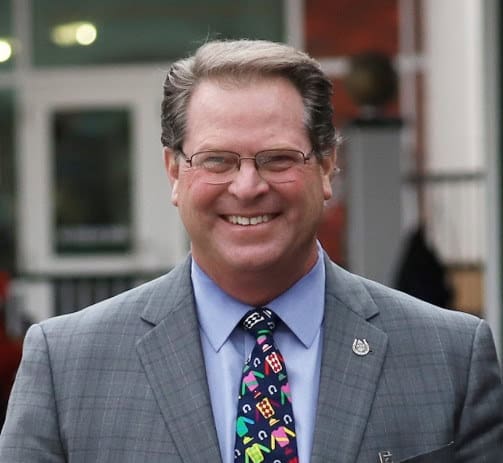
National HBPA CEO Eric Hamelback (Photo by Gwen Davis)
In every industry, there is a difference between governance and marketing. Between authority and advertising. Between statutory responsibility and institutional ambition.
In Thoroughbred racing, that distinction matters.
The Horseracing Integrity and Safety Act created the Horseracing Integrity and Safety Authority (HISA) and its enforcement arm, the Horseracing Integrity and Welfare Unit (HIWU). Agree or disagree, their mandate is clearly defined in a federal law. It is not philosophical. It is not aspirational. It is definitely not emotional. However, it is regulatory.
The act passed in 2020 with a specific purpose: to establish uniform medication control and racetrack safety standards for “covered” horses, persons and races subject to the act by election of a state racing commission or breed governing organization. That is a very defined lane. Anti-doping. Medication control. Track safety. Enforcement mechanisms. Nothing more was written into the legislation.
Yet, increasingly, we in the industry are seeing something else.
We are seeing messaging that positions HISA not simply as a regulator but as a moral compass. A cultural leader. A convener of industry “governance.” A steward of aftercare. A voice on mental health. A banner carrier for overall reform throughout horse racing.
Let me be very clear: These are important issues. Aftercare matters. Mental health matters. The future of our sport matters deeply.
But importance does not equal jurisdiction.
The statute does not direct HISA to oversee retired racehorse aftercare. It does not authorize it to lead industry governance discussions. It does not task it with serving as the central voice for social initiatives. It does not give it authority to redefine the business structure of racing. It regulates covered horse racing, which only includes medication, safety protocols and enforcement within that framework.
When a regulator moves beyond its defined scope, that is not evolution. It is mission creep.
Mission creep often begins subtly. It begins with language, including words and phrases like “leadership,” “industry stewardship,” “holistic welfare” and “governance.” It continues with partnerships, summits, task forces and position statements that imply a broader mandate than the law provides. Eventually, perception becomes reality. I have said this before and will again: Perception is not reality; reality is reality.
If enough people begin to believe that one federally created body is the “leader” of the industry, its practical influence grows beyond its statutory authority. That influence may not be grounded in the act, but it becomes embedded in public perception, and perception can be very powerful.
Why does this matter?
Because HISA is not a trade organization. It is not an association of horsemen. It is not a recognized horsemen’s representative. It is not a breed registry. It is not a charitable aftercare coalition. It is not a mental health nonprofit. It is not a policy think tank.
HISA/HIWU and their staff are the current regulators and nothing more.
Regulators exist to enforce rules fairly and efficiently within defined boundaries. They are not designed to build consensus across unrelated sectors. They are not designed to serve as the public face of an entire sport. And they certainly are not designed to expand into every corner of our industry’s ecosystem.
When regulatory bodies seek to occupy moral or cultural high ground outside their lane, two problems arise.
First, accountability blurs. If a regulator presents itself as a benevolent industry leader rather than a neutral enforcer, it becomes more difficult to scrutinize its costs, structure and performance. Criticism of its efficiency or constitutional framework can be framed as opposition to “reform” or “welfare” rather than legitimate oversight of a regulatory body.
Second, costs demand justification.
HISA is funded by the industry. Horsemen, owners, breeders and racetracks are ultimately bearing the financial weight. When assessments are substantial, the pressure to demonstrate relevance increases. If the measurable outcomes of medication control and racetrack safety do not, in the public eye, justify the expense, expanding into visible, emotionally resonant areas becomes tempting. Sound familiar?
Aftercare photographs. Mental health panels. Governance summits. Industry-wide messaging campaigns. These are persuasive optics. They resonate beyond the backstretch. They generate favorable headlines. Optics are not statutory authority.
None of this diminishes the value of aftercare organizations, which were built by the industry long before federal intervention. None of this dismisses the importance of supporting the mental well-being of those who work tirelessly in this sport. Those efforts deserve respect, and they deserve to be led by organizations whose missions are designed for that work.
The concern is not about compassion. The concern is about concentration of influence without statutory grounding.
Federal law did not nationalize governance of the Thoroughbred industry. It was created to develop a uniform regulatory framework for medication control and racetrack safety within covered horse racing. That distinction is critical.
Centralizing moral authority in a single regulatory body, especially one whose constitutionality has been litigated repeatedly, should give every stakeholder pause.
The future of racing will not be secured by branding exercises. It will be secured by economic sustainability, sound horsemanship, responsible regulation and respect for statutory boundaries.
If HISA focuses narrowly and effectively on medication control and racetrack safety by executing those responsibilities efficiently, transparently and cost-consciously, it can justify its existence within the framework Congress established.
But when it ventures into areas outside its mandate, it invites legitimate questions:
• Who authorized this expansion?
• Who oversees it?
• Who pays for it?
• Who benefits from the consolidation of influence?
This is not about hostility. It is about governance discipline.
Regulators should regulate. Trade groups should advocate. Charities should provide care. Mental health professionals should lead mental health initiatives. And industry governance should remain a shared responsibility among stakeholders and not serve as a branded platform.
The Thoroughbred industry does not need a single entity declaring itself the leader. It needs clarity of roles, respect for jurisdictional boundaries and fiscal accountability.
Emotion can be persuasive. Advertising can be powerful. But federal law is specific.
The lane is defined. Staying in that lane is not obstruction; it is responsible governance.
As we look toward the future of our sport, let us commit to doing the hard work where it belongs. Let us support aftercare through the organizations built for that purpose. Let us strengthen mental health resources through appropriate channels. Let us invest in safety and integrity through clear, accountable regulatory structures. And let us ensure that no entity, however well-intentioned, expands its footprint beyond what Congress authorized simply to gain favor or justify cost.
Racing deserves discipline. Horsemen and women deserve representation. And regulation deserves boundaries.
Sincerely,
Eric J. Hamelback
National HBPA CEO