
Survey Documents Human-Use Pharmaceuticals in Horses’ Drinking Water at Some Tracks
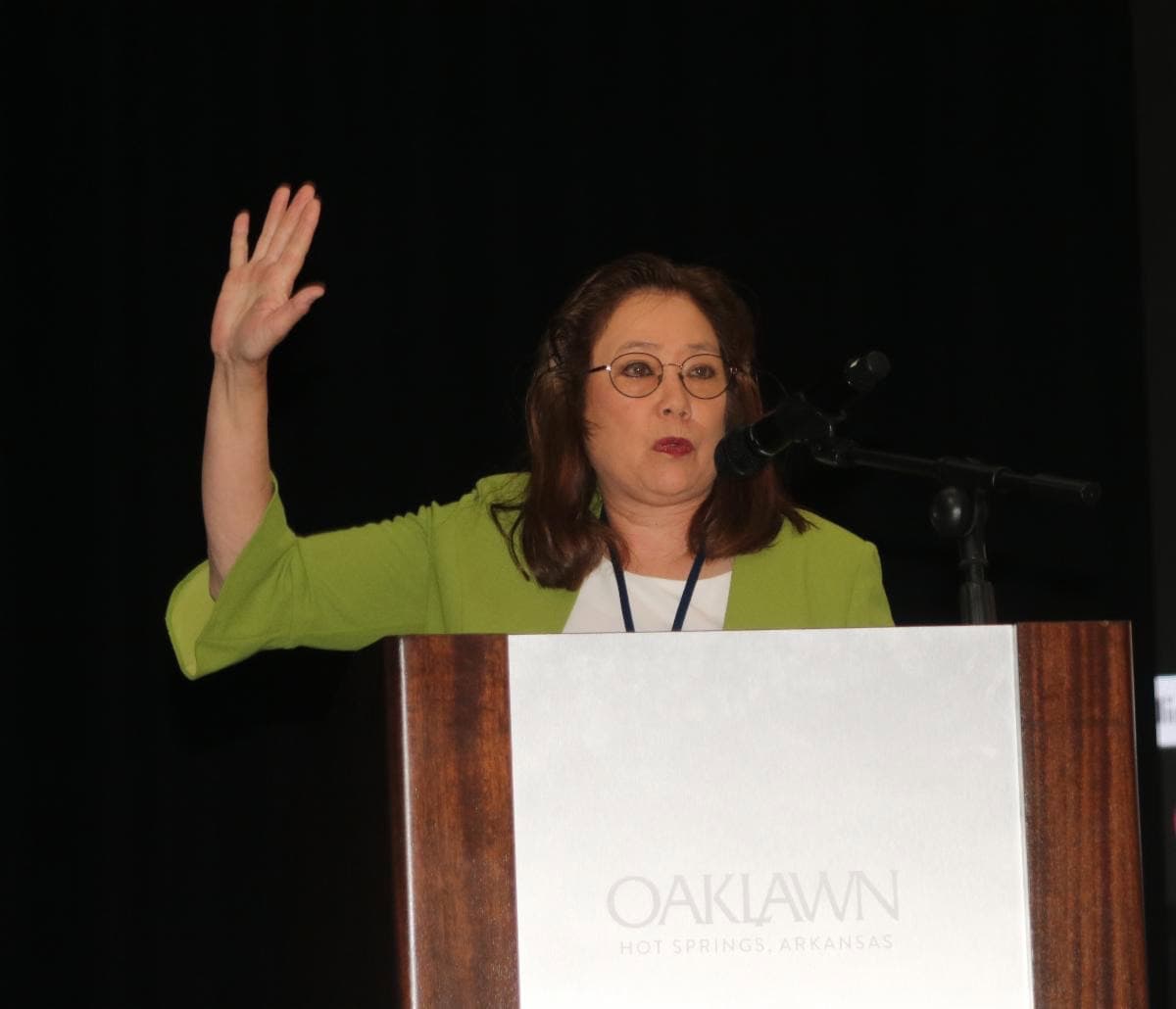
Dr. Clara Fenger (Photo by Denis Blake/National HBPA)
For Dr. Clara Fenger, testing the waters is not just a saying but a mission.
The Lexington, Ky.-based racehorse veterinarian and researcher has worked tirelessly the past few years to get water samples from backstretches across America to learn what horses might unwittingly be drinking at the track.
Fenger works closely with the National HBPA, serving as the national organization’s veterinary advisor along with the University of Kentucky’s Dr. Thomas Tobin. Fenger, Tobin, National HBPA CEO Eric Hamelback and others long have been convinced that certain substances showing up in horses’ post-race tests are the result of environmental contamination or transfer that could not be prevented by the trainer. Fenger set out to prove that, working with the U.S. Geological Survey to get the water tested, for which the agency in the Department of the Interior is uniquely qualified.
At Friday’s closing-day panel of the National HBPA Conference at Oaklawn Park, USGS environment chemist Kelly Smalling presented the preliminary results during the annual Kent Stirling Memorial Scientific Panel.
“The goal was to determine if racehorses are exposed to low levels of human-use pharmaceuticals through the drinking water at racetracks during racing seasons across the country,” said Kelly, who is working with Paul M. Bradley on the USGS Environmental Health Program’s equine exposure pilot study.
The results say they are.
Speaking remotely, Kelly said 35 samples to date were collected from 16 states and two Canadian tracks, with sample kits delivered to participating barns. Detailed instructions were given for collecting and providing critical information about the procured water samples. Each returned sample was analyzed for more than 80 human-use pharmaceuticals, she said.
The early findings:
// At least one pharmaceutical was observed in 74 percent of the samples.
// Nine racetracks had no detections in their drinking water.
// Concentrations for the test substances ranged from not detected to 985 nanograms per milliliter, with the average being 32 ng/L.
The 25 substances that were observed at least once included Atrazine (a pesticide that appeared in 14 samples), Methyl-1h-benzotriazole (which has industrial uses, in 13 samples), the anti-fungal Fluconazole (10 samples), nicotine compound Corinne (nine), caffeine (eight) and the diabetes drug Metformin (seven). Metformin, one of the most used human medications in the world, early on surfaced as the poster child for environmental contamination in racehorses, with the Horseracing Welfare & Safety Unit (which oversees drug testing and enforcement for the Horseracing Integrity & Safety Authority) recently increasing the amount that must be detected in a post-race test before an adverse analytical finding is called.
Also found in drinking water at the tracks: the muscle relaxant Methocarbamol (five), the analgesic Acetaminophen (four), anti-anxiety agent Meprobamate (three), fly spray Piperonyl Butoxide (four), Topiramate, an anti-convulsant/migraine medication (four) and others that included stimulants, local anesthetics, sedatives and antibiotics.
Participating tracks or horsemen’s associations received reports about their sample, with no individual track locations publicly identified, though there are generalizations. That includes more than 10 substances being detected in some samples in Kentucky along the Ohio River.
Fenger said the results back up what the National HBPA and others have advocated for years: that the authorities setting racehorse drug-testing policies need to establish realistic threshold levels that reflect today’s contamination realities and the lack of any pharmacological effect in such trace amounts.
“It’s really important for us to use this information to put pressure on our regulators to adopt rational thresholds for things that are stable in the environment,” Fenger said, meaning the substances don’t readily break down and instead hang around in a horse. “And all of these substances that we’re finding in water are going to be stable in the environment.”
Kelly said the next step is to start interpreting the data in conjunction with Fenger and Tobin, a world-renowned expert on equine pharmacology and drug testing.
“We just hope this is helpful to the racetrack community and gives you guys information to help protect yourself and your horses,” Kelly said.
Fenger urged horsemen’s associations that have not yet had their tracks’ water supply tested to do so. The cost of the water testing has been mostly funded by the HBPA affiliates. Fenger suggested to those who have not contributed to the cause, “write a check.”
Also during the scientific panel:
Keegan: “Honor the burden of proof before you impose the burden of compliance.”
Dr. Kevin Keegan is an equine surgeon and University of Missouri professor who collaborated with engineering teams to develop the body-mounted inertial sensor system known as The Q with Lameness Locator. He said he researched Kent Stirling in advance of his Friday presentation and was impressed with what he learned about the former trainer who became a powerful advocate for horsemen in his long tenure as executive director of the Florida HBPA.
“I came away with a genuine respect for him,” Keegan said, “because he seemed like somebody who was not just reflexively against rules, but he was fighting against bad rules. His view, I think, was very simple, that if you’re going to restrict what trainers and horsemen are going to do with their horses, you need to prove first that whatever regulations you enforce, there’s a chance that it’s actually going to help.
“We should honor the burden of proof before you impose the burden of compliance. This principle should apply to everything in racing — not just medication, but in training protocols, veterinarian examination requirements, racing procedures and any kind of screening program that is proposed. It should all pass the same test, and that’s what the evidence says, not just because it looks good for a press release. Or not because it’s going to satisfy the legislators who maybe don’t know anything about racing, though that’s important, too. But that’s not going to solve the problem of racetrack breakdowns.”
For example, Keegan said there is a place for wearable technology but cautioned against using it to determine what horses can run and who can’t. He also questioned some of the statistical methodology employed.
“I think most agree — or at least admit — that the majority of catastrophic, musculoskeletal breakdowns are not random events,” Keegan said. “They’re at the end process of something that has been going on for weeks, possibly months, possibly years.”
He addressed how best to find a pre-existing condition. Keegan doesn’t believe the best way is wearable technology — devices attached to the horse that measure how the horse is moving in a race or training and then it creates a risk score.
“I actually think this concept of measuring a horse’s movement with sensors is a scientifically valid thing to do, because horses do move differently when they have lameness, when they have pain,” he said. “And they frequently do it in ways that are too subtle or too quick, so that you’re not going to see it.
“But before we mandate or suggest or propose any program built on these wearables, at least in my mind, two things have to be enforced. That is, we should actually know and understand what is being measured — physiologically, anatomically. They have to explain what it is that they’re measuring. So this black-box approach that gives you a score, without explaining specifically what that is, that’s not going to be very beneficial…. The second thing that we should insist upon is that the statistics work, so that the statistics are clinically meaningful and practical.”
In Keegan’s opinion, a better solution is regular lameness monitoring and the use of 3D imaging with standing CT scans performed after exercise for detecting bone pathology.
Meyer: “We don’t measure to reduce horses to simple levels. We measure the data because each horse matters.”
Panelist Dr. Jim Meyer is an equine veterinarian and clinical researcher with more than 30 years of experience practicing in North America and abroad. He also has a master’s degree in medical statistics from the University of Oxford. His current research is focused on large-scale data analysis to better understand injury patterns and pharmacoepidemiology in racehorses, with the goal of improving safety and welfare in Thoroughbred racing.
Meyer emphasized that catastrophic fatalities in a race are extremely rare. Noting that equine fatalities since the national Equine Injury Database began in 2009 are down 40 percent, he said it’s misleading to focus on the fluctuations from one year to the next, let alone quarter to quarter, as HISA has done.
American racing fatality rates are calculated for those who die within 72 hours of injury in a race, with the denominator being the number of starts times 1,000.
“One of the challenges … is it’s a mixed group,” Meyer said. “It includes starts, but each individual horse in the data set may not have one start. They may have multiple starts, whereas some horses will have few starts, and the one with more starts contributes more to it. Potentially, there’s some survivorship bias. The horse that runs more may be healthier in many ways, so that potentially dilutes the number. Also, there are different trainers, different tracks, different track surfaces — all mixed into one number. And that can change over time.
“We know that since the data started, a number of racetracks are no longer around. Obviously, there are trainers no longer around. In the mix of horses, the risk profile of the horse may have changed in 2009 to 2024. …. There’s a lot of uncertainty in these numbers.”
Meyer said that publicized percentages of decline or increase over a short period of time deserve scrutiny in such a small sample.
“Some tracks have no fatalities, but if they had one and then you go to three the next year, that 200-percent increase sounds incredible,” he said. “Every fatality is important, but two may not be as alarming as saying 200 percent. So be careful when you read about percentage changes.
“… There’s no doubt that the numbers are dropping. Is that a change in the denominator? Is that a change in the risk profile? Were tracks that aren’t around anymore more dangerous?… Everybody can give you an opinion, but I can’t say with certainty. But the overall trend is a decrease.”
Meyer compared it to evaluating the stock market.
“If you pick segments of the data, if you take two years or one year, you’ll certainly come to conclusions that we have a crisis, or that we made a breakthrough, or that we’re stalled — similar to stock-market movements,” he said. “Look at the Dow Jones. The trend is up (over the long haul). But there’s obviously ups and downs in that.”
Meyer praised the Equine Injury Database for being transparent and “really useful.”
“I got all of this online,” he said of the statistics he presented during the panel. “It’s available. The numbers are there. Not all tracks put their data online, but many do. It’s useful for watching trends. I don’t think it’s particularly useful for reacting to a single-year change, which is frequently what grabs the headlines. I’d be cautious comparing small groups, cautious with small tracks with few races. You can use it to compare between surfaces, ages, distances, et cetera. You can generate hypotheses that can be tested. So it gives us an overview. But be careful celebrating that one year — or panicking if the rate goes up.
“Let’s remember these are numbers. Every number in this data set represents a horse. A horse that someone bred, trained and someone got up very early in the morning to take care of. They represent the dreams and hopes of people and inspired us with an incredible athletic activity. But we don’t measure to reduce horses to simple levels. We measure the data because each horse matters.”
Tobin: “Horses are very capable chemists”
Based on his team’s latest research, Tobin told the conference that determining medication overages and drug violations in horses’ post-race testing should be based on relevant findings in plasma, not urine. He said urine testing readily detects pharmacologically irrelevant concentrations of substances that are almost always greater than the plasma concentrations.
“Horses are very capable chemists,” Tobin said. He said molecules that go into horses’ liver can be excreted at extremely high concentrations in urine.”
He said the classic example is Detrorphan, which can be excreted at 361,300 times the level in plasma serum. His suggestion is to avoid urine testing when possible and to define specific pharmacologically irrelevant screening limits in plasma testing. The screening limit would be a defined concentration below which an identification would not be “called.”
laCour: Horsemen have opportunity to use racing, betting data and AI to improve purse revenue
CHRIMS Inc. President Gunner laCour’s annual presentation typically focuses on his non-profit company’s daily auditing capabilities to help horsemen identify exactly how much money they have coming in from various revenue platforms. CHRIMS specializes in parimutuel wagering and historical horse racing (HHR) distributions, settlements, auditing and reporting as the only independent provider of settlements in the United States. His advice for horsemen has been “trust but verify” when it comes to ensuring they are getting everything they have due contractually from a track.
But there’s another use for that data, laCour said Friday. That’s working with tracks’ racing offices to find the sweet spots that will enhance revenue for horsemen and the tracks.
“How powerful that information could be if you combine it with your racing data,” he said, speaking remotely. “AI is an amazing tool. It’s a great resource for looking at lots of data and getting you good information. The best thing this industry can do from a technological standpoint is work with your racing data and your wagering data. Bring those things together (to determine) what every single race you’re putting on a card is potentially going to do for you. Certainly AI can look at your race data and say how competitive is this race going to be? Or if I put this race up, how likely will it be to fill?
“Equibase does have racing data at a top level. But to really understand what’s generating the best return to the track and the horsemen, they need to look deep at the wagering offerings. I’m talking about things like: If I have this combination of horses and those combinations and races, and races in this order, and if I put up this wagering menu with those races, how can we extrapolate how that might generate revenue for us? What historically has that done for us? If we put it in this sequence vs. that sequence?”
laCour said that could result in the best possible card for the best returns to support the track and horsemen.
“It’s very deep analytics, and very complex,” he said. “But having sort of a goal in mind, AI can help you get there. Again, you have to have the data to be able to feed into it. You can answer questions, ‘Is this wagering option a success compared with others?’ ‘Is how we set this card up a success? And where is that success: ADW, high-volume guys? Where should we be pushing it?’ Then you take that a step forward and talk with the track about setting conditions for the next racing season: stakes, overnights, state-bred races, purses, etc. It would be a really helpful piece of information.”
By Jennie Rees, National HBPA communications
ICYMI:
Predict this: Will racing go to court or try to cash in on prediction markets?
Jockey Club’s Dobson delivers message of collaboration during keynote address
Day One session recaps: Panel says racing would be smart to embrace AI
Video: Oaklawn’s Nancy Holthus interviews HBPA Living Legend Jinks Fires